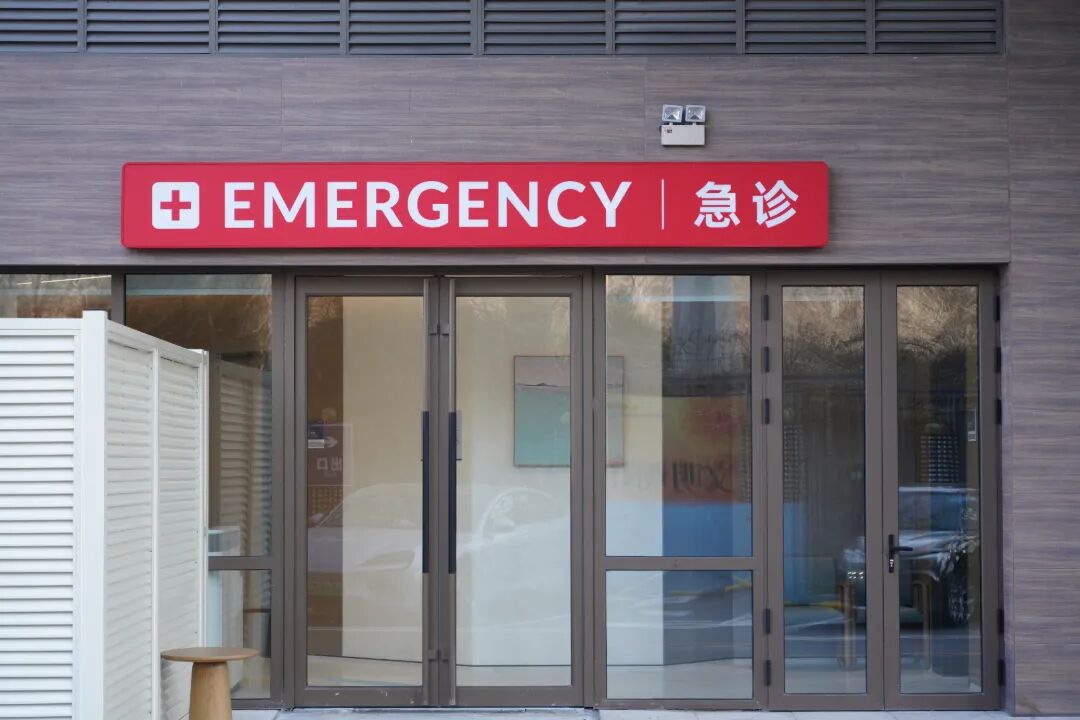
2:30 a.m., Observation Room
Nurse Guo peeled the tape away from the cannula slowly, so the pull would not register as pain. Guoguo stirred, then opened his eyes. He had been carried through these doors in the early evening with his face pressed against his mother's shoulder. From that moment to this one was seven hours, and in those seven hours six departments had held him in turn: emergency, paediatric surgery, aesthetic medicine, the paediatric ward, anaesthesiology, and the operating theatre.
His vital signs were steady. The cannula came out, the site was checked, and the family left for home a little after 2:30 in the morning. The child will not remember any of it. Everyone else involved will remember the details.
The First Line: Assessment Before Repair
It began with a scream that cut across the emergency hall. Guoguo — a pseudonym; he was one month short of his second birthday — had a lacerated brow that was still bleeding. Blood ran down past the eyebrow and left streaks across his cheek; one side of his collar was soaked. His mother was crying, and her hands were shaking.
Nurse Tong reached them first. Her job in those opening seconds was not the wound. It was to hold the boy's head still so the wound would not be struck again, and to steady a parent who could not steady herself.
Dr Ge, the surgeon on duty, arrived directly after. She pressed sterile gauze over the cut, and while she held it she ran the assessment that decides everything that follows: was there any sign of intracranial bleeding? Any projectile vomiting? Any of the high-risk signals that would turn a facial wound into a neurological emergency? Only once those were excluded did the wound itself become the question.
It was deep. Below the skin, the tissue layers were involved. It would have to be closed.
There was one more thing to rule out. An ECG trace came back abnormal. Paediatric surgery was called for a consult, then Dr Xu from anaesthesiology assessed the child, and the conclusion was that the abnormality was an artefact of a screaming, thrashing two-year-old rather than a cardiac finding. With that excluded, closure could be scheduled.
Why the first ten minutes are not about the cut
A bleeding forehead is the most visible problem in the room and the least dangerous one. The order of assessment is deliberate: airway, neurological red flags, then the wound. A child who is alert, moving all four limbs and not vomiting has already been cleared of the things that would change the plan entirely. Everything after that is craftsmanship.
Two Ways to Close a Child's Face
The wound sat on the brow, and that location forced a choice. It could be closed by the paediatric surgical team in the standard way, or by the aesthetic medicine team using a fine-closure technique. Either route required general anaesthesia. That single word was where the father stopped.
Would anaesthesia affect his son's memory? His intelligence? How many stitches? How long would it take? Which one would leave the smaller scar?
Dr Ge answered each question in order, without hurrying. At not quite two years old, a child cannot cooperate with a repair on his face; general anaesthesia is not a convenience, it is what makes a safe and accurate closure possible. On the choice of technique, she set out the difference plainly. Standard closure is built around restoring function: the wound is brought together, it heals, and it commonly leaves the laddered, centipede-like scar that most parents recognise. Aesthetic closure works on tension instead — the deeper layer is released so the skin edges meet under low tension, with finer suture material and closer needle placement, so the scar that forms is narrower, shallower, and often reads as a single fine line.
The stitch count was not the deciding factor. Both routes came to roughly five or six stitches and took a similar amount of time. What differed was the scar the boy would carry above his right eye for the next eighty years. After going through it more than once with the family, the parents chose aesthetic closure.
One Child, Six Departments
Dr Ge's next calls went out at night. Dr Xie from aesthetic medicine and Nurse Guo were both off duty; both got up and drove back in. Anaesthesiology, the operating theatre and the paediatric ward came online in parallel. The chief nurse on duty stayed by the telephone, ready to step in if anything moved.
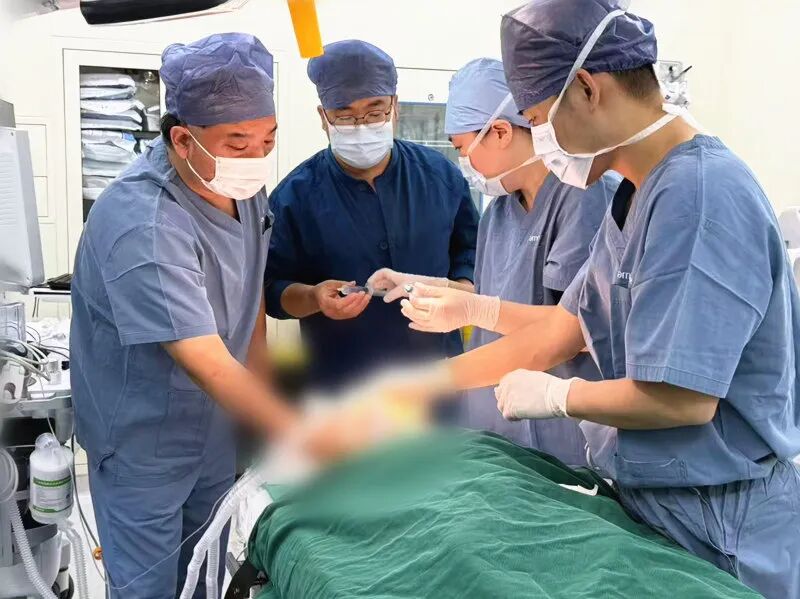
There was a delay that no amount of staffing could remove. General anaesthesia requires an empty stomach, and the child had eaten dinner not long before he fell. The fasting interval is four hours. The earliest safe start was 11:30 that night.
Those hours were not idle. Pre-operative checks were completed, contingency plans were laid out, the parents were talked through what would happen and in what order, and an observation room was prepared with a bed and warm water so the boy could sleep while he waited. A child who arrives at the theatre calm and rested is a safer child to anaesthetise than one who has spent four hours crying in a corridor.
Twenty Minutes, and a Plan Behind Them
A conventional closure here would have placed a series of individual stitches — the team's own estimate ran to eight or ten passes — each of which has to be lifted and pulled when the sutures are removed. Every one of those is a small pain, and a two-year-old experiences them all at once.
Dr Xie designed the closure differently. The tension-relieving layer went in first, under the skin, where the pull on the wound edges actually lives. The skin itself was then closed in two continuous runs, one intradermal and one external, with knots only at the two ends. When the time comes to remove them, the thread is simply drawn out — two knots instead of ten, and a child who does not have to be held down for the process.
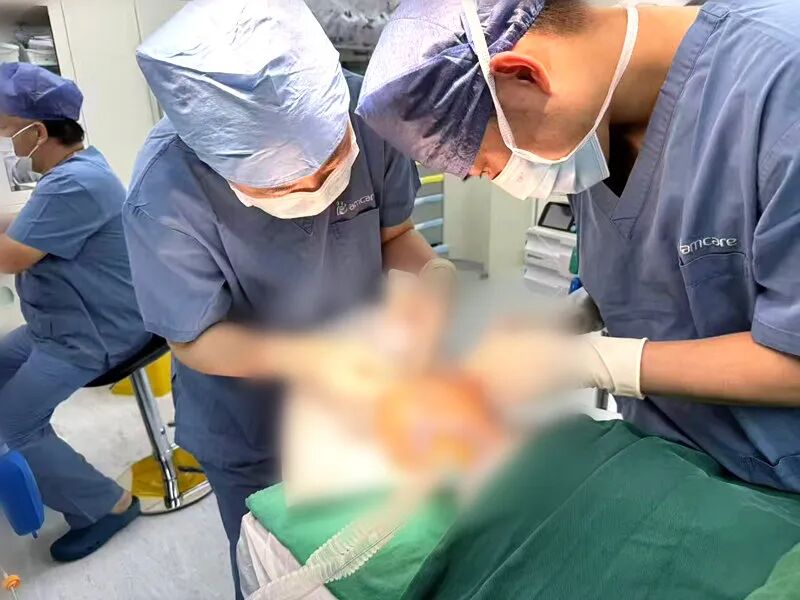
It is more work. There is an additional layer to close, and it takes longer than closing skin in one pass. The trade was made deliberately: more time in the theatre, less pain afterwards, and a smaller scar.
Dr Xie then spoke with Dr He in anaesthesiology and matched the two together. The repair would take about twenty minutes, so the anaesthetic was planned for about twenty minutes — no deeper and no longer than the procedure required. At 11:30 p.m. the fasting window closed and the case began without a gap.
After the Last Stitch
Aftercare was planned before the family left. Dr Xie prescribed a scar gel rather than a silicone sheet, and the reason was anatomical: the wound sits along the eyebrow, the boy blinks constantly, and an adhesive patch would never stay in place there. The scar is thin and its position is fortunate — the eyebrow covers it, and in ordinary view it will not draw attention.
What she did not do was promise it away. The injury was deep enough that the scar cannot be erased entirely. What surgery can do is make it small, keep it flat, and put it where the face already has a line.
By 2:30 a.m. the cannula was out, the boy was stable, and the family went home. Seven hours, from the door to the door.
What those seven hours actually bought
Someone examined the wound and excluded the dangerous diagnoses first. Someone came back from home in the middle of the night. Someone matched an anaesthetic to a twenty-minute procedure to the minute. Someone redesigned a closure so that a two-year-old would not have to be restrained for its removal. None of that appears in a photograph of a stitched brow. All of it is what the scar will look like in five years.
For Families Arriving From Abroad
Facial injuries in small children are one of the few problems that cannot wait for a scheduled appointment, which makes them disproportionately difficult for families who are newly arrived in a city. Three practical points are worth knowing in advance.
The first is that a paediatric facial laceration should be assessed for neurological red flags before anything is done to the wound itself. If a child has vomited repeatedly, lost consciousness, or is unusually drowsy, that takes precedence over the repair and may require imaging.
The second is the fasting rule. If a child has eaten within four hours, general anaesthesia cannot safely begin, and no amount of urgency changes that. Arriving with an empty stomach — or knowing that the wait will be four hours — makes the night considerably calmer.
The third is that the choice of closure technique is a real choice, and it is worth asking about explicitly. Not every facial wound needs an aesthetic closure, and not every hospital offers one for children. But for a laceration on the face, the difference between a standard closure and a tension-relieving one is not cosmetic vanity; it is the difference between a mark that fades into the brow line and one that does not.
AMCARE's emergency department operates around the clock, with paediatric surgery, anaesthesiology and operating theatre support available overnight. International patients can reach the international patient team in advance for language support and insurance pre-authorisation, or simply arrive — the emergency pathway does not depend on a booking.
Patient-Centred Is a Timetable, Not a Slogan
Hospitals describe themselves as patient-centred constantly, and the phrase has largely stopped meaning anything. It becomes legible only in specifics: a nurse who steadies a mother's shaking hands before she looks at the wound; a surgeon who explains two techniques until a frightened father can actually choose between them; an anaesthetist who plans twenty minutes because the surgery takes twenty minutes; a team that comes back at midnight for a cut above an eyebrow.
At 2:30 in the morning, in an observation room, someone said quietly that the child had woken up. That is the whole of it. Seven hours, six departments, one small boy who will never know how many people were awake because of him.
This account is published with the family's consent. The child's name has been changed. Clinical details are described for general information and do not replace assessment by a treating physician.