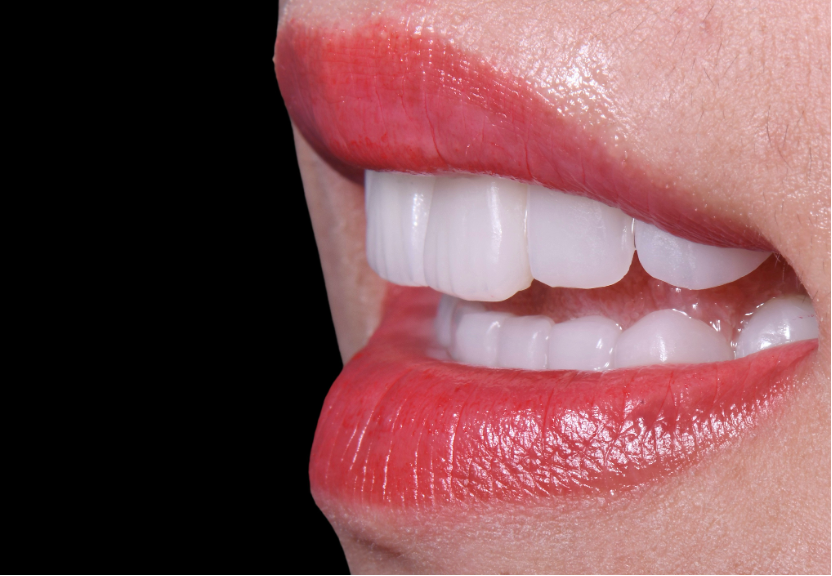
The Problem With "Just Make Them White"
As more people treat a good set of teeth as part of how they present themselves, dental aesthetics has moved from a niche upgrade into something patients research seriously. That is, on the whole, a good development. But it has also created a market in which the fastest route to a bright smile is often the most destructive one.
The pattern is familiar. A patient asks for "porcelain-white" teeth. To make the veneers fit and look uniform, healthy enamel is ground down — sometimes aggressively, sometimes across the whole arch. The result photographs well for a few months. Then the consequences arrive: teeth that are thinner than they were, a bite that no longer meets the way it used to, sensitivity to cold, and edges that chip because there is less tooth left to support them.
Teeth are not a cosmetic surface. They are load-bearing structures attached to a living periodontal system. That is the premise the AMCARE dental center works from, and it shapes every decision in a veneer case — starting with how much tooth, if any, gets prepared.
Less Reduction, Larger Change
The single most common concern patients raise about porcelain veneers is the drilling. It is a reasonable fear. When an operator's only objective is speed and uniformity, the simplest way to seat a veneer is to remove enough enamel that the new shell can be thick, opaque and identical tooth to tooth.
The clinicians here take the opposite position, and are deliberately conservative about it. The design principle is minimally invasive first: no full-mouth reconstruction as an opening proposal, no blanket preparation of every visible tooth. Instead, the case starts from the logic of whitening — identify the few teeth that actually carry the smile, and intervene there.
In practice, that can mean four teeth. Not twenty-eight, not sixteen. Four.
A question worth asking before you look at the answer
Look at the photograph below and try to judge how many teeth were treated. Most people guess high — eight, ten, a full upper arch. The answer is four upper incisors. Getting a natural result out of four teeth, while the untreated teeth beside them still have to match in shade, is where technique and aesthetic judgement separate.
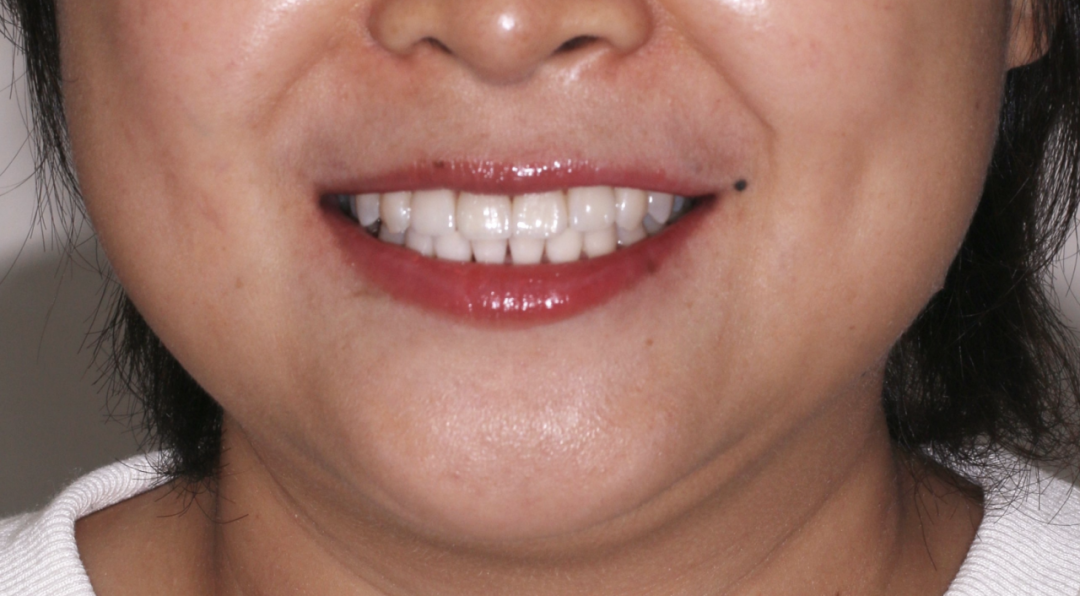
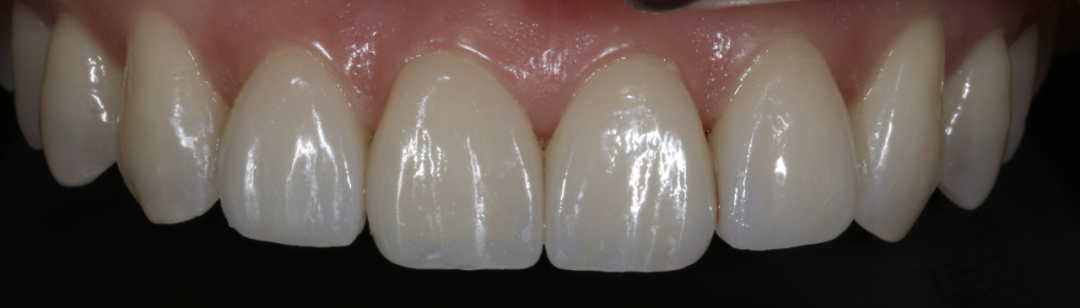
That is also why the colour work is the hardest part of a small case. A single shade chosen for four teeth will not match a natural dentition that varies across the arch. The clinician has to read the neighbouring teeth, decide how the restored teeth should sit slightly brighter without becoming a different species, and then hold that decision through try-in and cementation.
The Material Is a Long-Term Decision
Veneer outcomes depend heavily on what the veneer is actually made of. Three properties matter, and they pull against each other: hardness and wear resistance for daily chewing, bond strength at the tooth interface so the shell does not debond, and optical behaviour — translucency and depth — so the result reads as enamel rather than as ceramic.
The ceramic used here has a hardness of 600 MPa, marginally harder than natural tooth structure. That is a deliberate specification rather than a marketing number: a shell at that hardness can carry normal occlusal load without the material itself becoming the weak point, while not being so hard that it wears the opposing teeth.
The bonding system has been refined over successive generations — the combination of ceramic surface treatment, adhesive and resin cement is what keeps a thin shell attached through years of chewing and temperature change. It is unglamorous work, and it is the difference between a veneer that stays on and one that comes back.
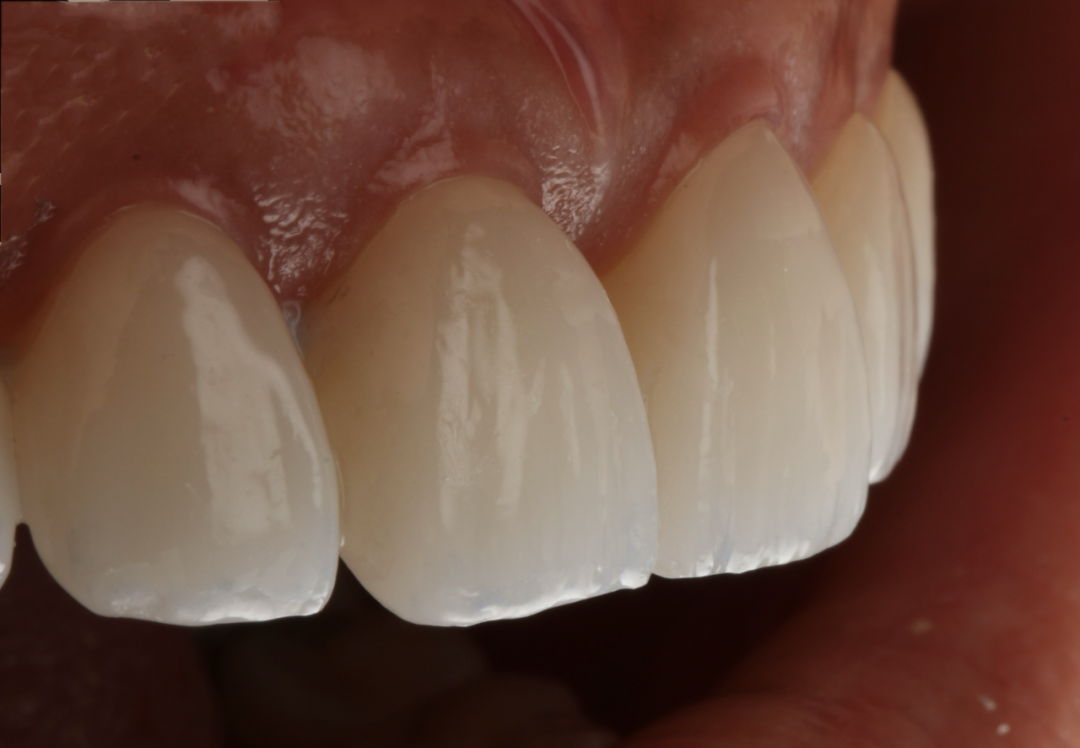
Shade matching for Asian patients is a specific problem, and one the material choice has to serve. The optical target is not the bluish-white of a bleaching chart; it is a warm, slightly cream-toned enamel with enough translucency at the incisal edge to pick up the colour of the lip behind it. Get the value right and the tooth disappears into the face. Get it wrong and the eye goes straight to it.
The Part That Is Medicine, Not Cosmetic Work
A veneer is not a sticker applied to a tooth. It is a restoration designed around the periodontal condition, the occlusal relationship, facial proportions and the aesthetic standard the patient is asking for — four variables that have to be reconciled before anything is made.
That is why the assessment comes first. Before any preparation, the team screens gingival health and looks for hidden caries, and evaluates how the teeth are likely to behave over time. Aesthetic work is then built on a foundation that is stable enough to carry it. A patient with untreated gum inflammation or an undiagnosed cavity is not a candidate for elective veneers until those are addressed — and saying so is part of the job.
Pronunciation calibration: designing teeth around speech
One technique here is less common than it should be. Before the veneers are fabricated, the patient is asked to read a set text aloud and to produce four key syllable types. The clinician watches what the lips, tongue and teeth do at each one, and uses the observed positions to decide the correct height and angle for the restored teeth.
The purpose is straightforward: teeth that look right in a photograph but sit at the wrong labial angle will interfere with fricatives and sibilants. The patient ends up with a smile they like and speech that feels foreign — a slight lisp, a whistle on certain sounds, or a constant awareness of the teeth in the mouth. Calibrating the design against real articulation avoids that, and it costs one appointment.
Why "beautiful but awkward" happens
Most veneer failures that patients complain about are not failures of colour. They are failures of position: too far forward, too long, or at an angle that changes where the tongue meets the palate. Those are design errors, and they are far easier to prevent at the planning stage than to correct afterwards.
Made to Measure, Adjusted in the Chair
Much of the dental-aesthetics market runs on templates. One tooth shape is scaled across every patient, and because everyone receives the same proportions, the results share a family resemblance that has nothing to do with the person wearing them. Patients notice — usually as a vague sense that the smile is handsome but does not look like theirs.
Face shape, lip thickness and the arc of the smile differ from person to person, and they determine what a tooth should look like far more than any standard mould does. The dental center therefore runs an immediate-restoration model in which a dedicated technician is present on site during fitting. When the try-in is placed, clinician and technician look at it together against the patient's face and adjust length, width and contour in real time, rather than sending a revision request to a laboratory and waiting a week.
That on-site loop also makes it practical to build a multi-shade gradient into a single tooth — a slightly warmer cervical third, a more translucent incisal edge — which is what natural anterior teeth actually look like. Template work cannot do this, because a template has one colour.
What Happens After the Veneers Go On
A veneer is not a one-off transaction. How long it lasts depends substantially on maintenance and review — the part of the process patients tend to underestimate, and the part the clinic treats as part of the treatment rather than an optional extra.
- First review at one month. The focus is the occlusion: whether the new restorations are meeting the opposing teeth evenly, and whether any discomfort in use needs adjustment. Small occlusal corrections at this stage prevent much larger problems later.
- Then six- or twelve-month cycles. Once the first month is settled, the recall interval is set according to the patient's oral hygiene and periodontal condition, and continues indefinitely.
- Two professional care sessions in the first year, included. Veneer polishing and glazing, gentle cleaning of the natural teeth, and periodontal care — aimed at helping the ceramic integrate with the surrounding oral environment rather than sit in it as a foreign object.
The reasoning behind the polishing and glazing is worth stating: the surface of a ceramic veneer is what gives it its wet, enamel-like lustre. Over time, micro-roughness from brushing, diet and occlusal contact dulls that surface, and a dull veneer reads as older than it is. Re-polishing restores the optical quality without touching the tooth underneath.
If You Are Coming From Outside China
Dental aesthetics is one of the more practical reasons to combine treatment with a trip: the work is elective, the planning can be done remotely, and the visible result is immediate. It also carries a specific risk for travelling patients — a case designed and delivered in a short window, by an operator who never sees the patient again, is exactly the situation in which over-preparation and template design flourish.
Two things are worth doing before booking. First, send photographs — a full-face smile, a retracted view of the teeth, and any previous dental records — so that the clinician can tell you whether your case is a four-tooth case, a wider one, or not a veneer case at all. Not every aesthetic complaint is solved with ceramic; some are solved with whitening, orthodontics or a single crown, and a clinic that says so is more useful than one that does not.
Second, expect the plan to include a review after you go home. AMCARE's dental center can coordinate with the international patient team on scheduling, interpretation and records, and the one-month occlusal review can be handled with a local dentist using the documentation provided — but it should be planned for, not skipped.
In Closing
The change a set of porcelain veneers produces is immediate and visible: straighter, brighter, and a smile the patient is no longer editing in photographs. What matters more is whether that change is healthy and can be maintained — which comes down to a short list of decisions: how much tooth was removed, what the restoration is made of, who designed it, how it was fitted, and what happens at the review appointments afterwards.
That is what "a medical approach to something beautiful" means in practice. Restraint in preparation. A material specified for load and for light. A clinician who has examined the gums before discussing the shade. A technician in the room rather than a template in a catalogue. And a follow-up schedule that outlasts the honeymoon period.
The aim, in the end, is a set of teeth that is both good to look at and genuinely healthy — designed by someone who understands aesthetics, and who understands the person they are treating.
Reviewed by
Dr. Li Hao is an attending physician at the AMCARE Dental Center, having previously practised at Zuozhen Medical. A graduate of the Peking University School of Stomatology (master's degree), Dr. Li works on tooth whitening, aesthetic dental restoration and combined medical-aesthetic treatment, and is experienced in treating children, older patients and expecting mothers. She consults in English.
Thinking About Veneers?
AMCARE's dental center and international patient team can review photographs remotely, advise whether your case suits a minimally invasive veneer approach, and arrange assessment, treatment and follow-up in Beijing.